viernes, 27 de mayo de 2016

TEMPLES 2

In our last few days in Siem Reap we returned to Angkor Wat and looked at the wall carvings which we had skipped on our earlier visits. They are a mixture of Hindu mythology and (semi-)historical battles. There is a naval battle with the ocean full of fish and crocodiles, as well as scenes of city life, hunting etc. We went up to the temple of Preah Vihear on the Thai border. In fact it was part of Thailand for a couple of centuries but recovered by the French when they colonised Indo-China in the C19th. Thailand seized it again in the 60s, leading to a brief war. The International Court of Justice eventually gave it back to Cambodia. As a result it has a strong (if not very convincing) army presence. The Thai border is only half a mile away. We also went to Banteay Srei. Built by a senior minister in the C10th, it is smaller than the royal temples but beautifully carved. The harder stone used not only meant that the carving could be finer, but also that it is better preserved over 1,000 years later! It is amazing what the carvers managed to do with bronze tools. It is thought that the stones were polished by rubbing them against their neighbours to get the very tight fit. No mortar was used, although apparently a vegetable glue assisted in the construction process. Another remarkable feature is that the Angkoreans never discovered the arch, which is one reason the temples have fallen down. Also they were not always good at foundations, and in later years (2nd half of the C12th) they became lazy about overlapping the courses of stones, making the walls much weaker.

jueves, 26 de mayo de 2016

BATTAMBANG & SISOPHON

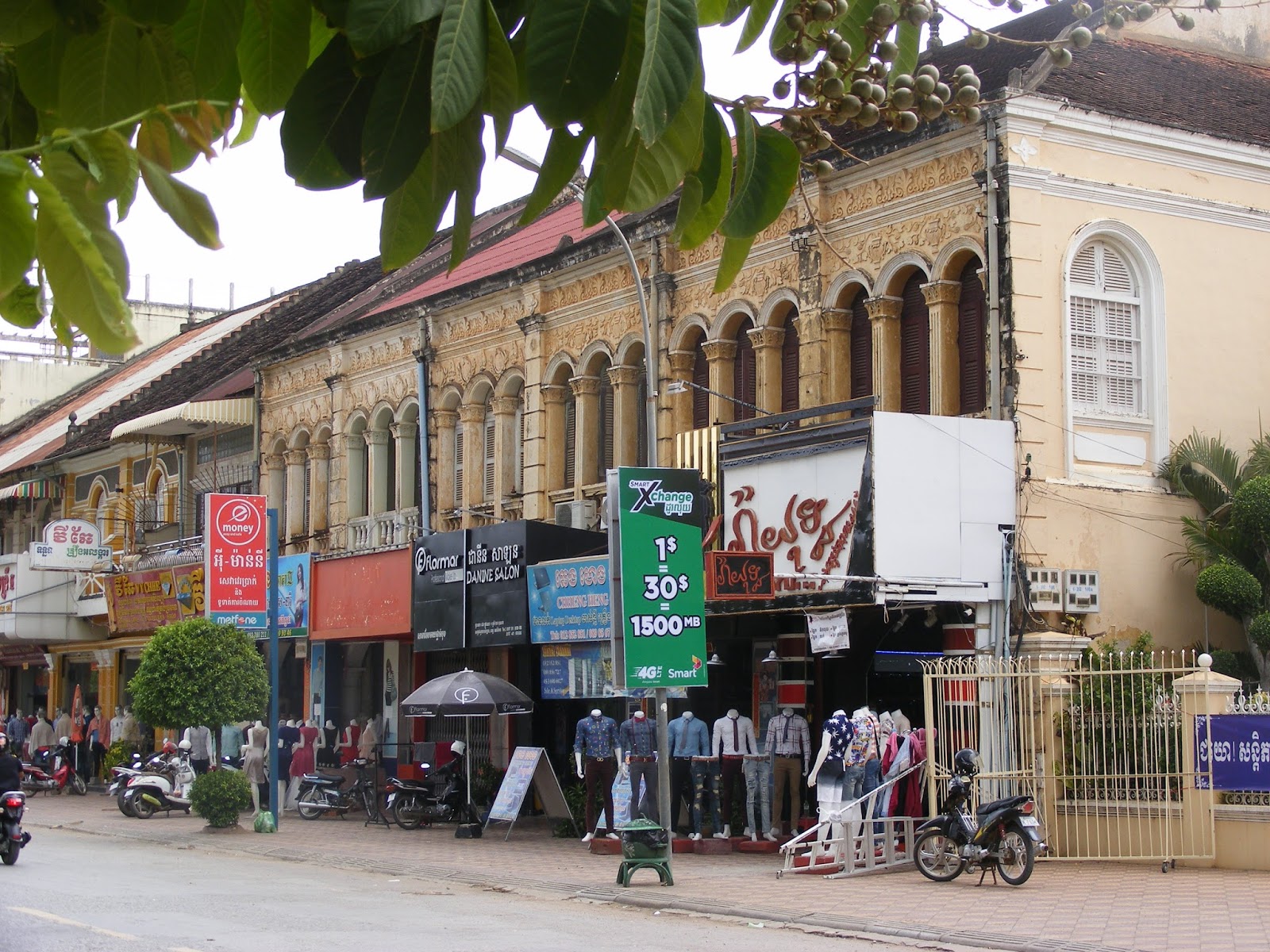
From Siem Reap we travelled some 3 hours west and then south via Sisophon to Battambang, a pleasant provincial town with some French colonial architecture including the Governor’s residence. It is easy to imagine it with a couple of pre-war Citroens outside. The "patron saint" of the city is the Black Man - legend says that he had a magic black stick which caused rice to turn black, and eventually his skin! Also it was supposed to come back like a boomerang... We spent a day here, visiting a small temple to the north (Wat Ek Phnom) which was not very interesting and rather badly damaged, mainly by the Khmer Rouge who stole many of the stones to build a new bridge! We then went to ride the Bamboo Railway, run by a young entrepreneur with whom I would not like to cross swords. The trip takes you 7 km down a bumpy stretch of the line to Phnom Penh 300 km away, closed since the 1970s. The track is uneven and twisted but more or less safe for the light wagons used – basically a wooden frame with a bamboo platform mounted on two axles with 8”diameter wheels! Propulsion is provided by a small 2-stroke engine driving the rear axle by a fan-belt. The clutch consists in sliding the engine aft until the fan-belt grips… At the end of the trip you can buy a cold coconut as well as the inevitable T-shirts and other souvenirs before rattling back again We dined in a very pleasant restaurant in another French colonial house, with menu offering Cambodian and European delicacies and properly kept wine. We closed with chocolate mousse! We also visited the old railway station where the time is forever 8.02... The next day we returned to Sisophon since the whole purpose of this expedition was to visit a remote temple, Banteay Chhmar. It was a large temple in rather bad repair, but has some magnificent bas-relief carvings round the outer wall colonnade – similar to Angkor Wat. Most have fallen down which has helped to preserve them. Some have now been restored and others will be in the coming years. Three particularly splendid and symbolic figures were stolen in the 90s by the troops posted to guard them… Sisophon itself had very little to offer, being dusty, dirty and poor in facilities. The new (prison-like) hotel had neither a bar nor a restaurant (never mind a swimming pool) so we had to go next door to one of two passable restaurants which we found in the city.

jueves, 19 de mayo de 2016

TONLE SAP

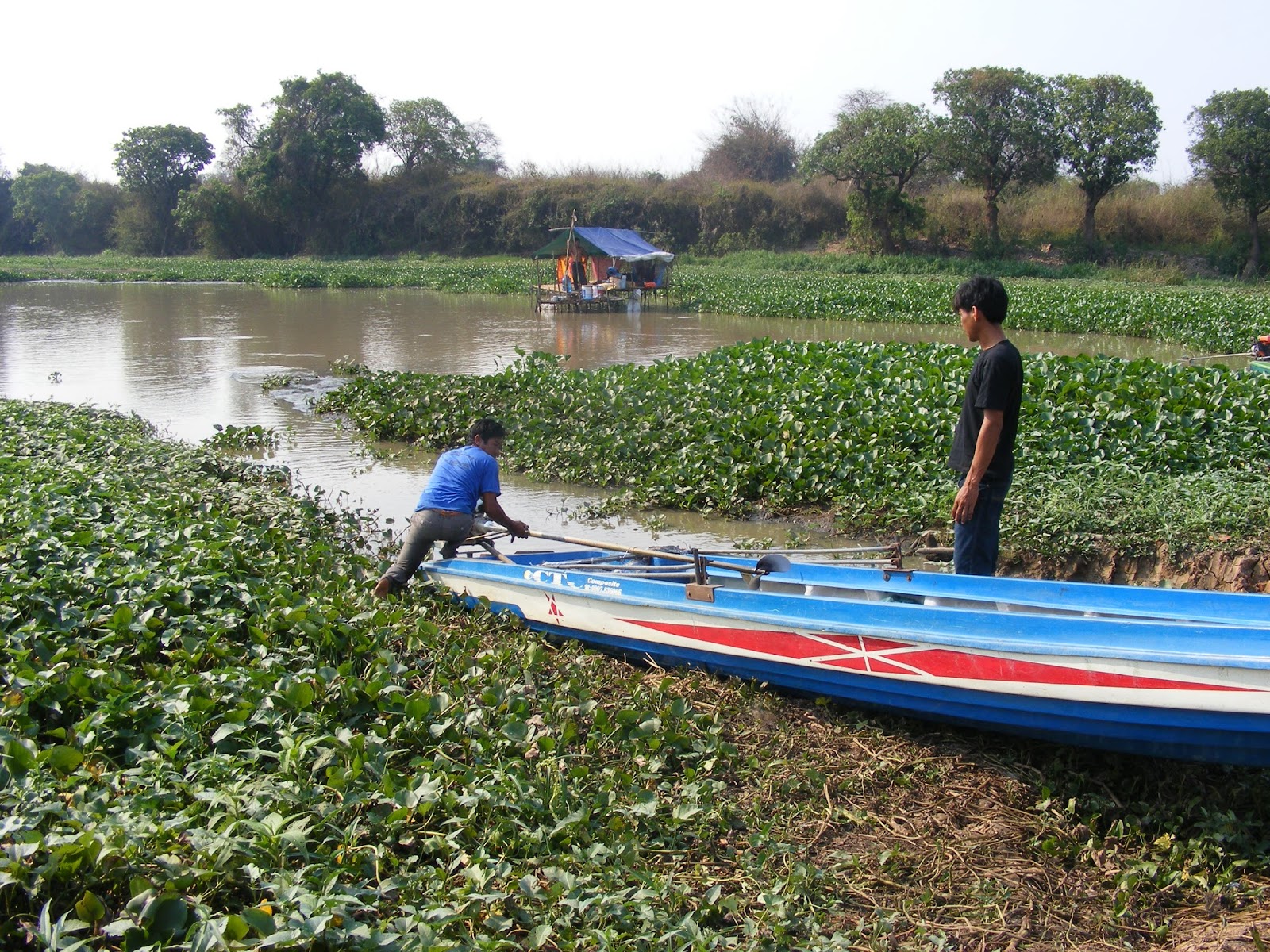
Tonle Sap Lake is the agricultural heart of Cambodia; the surplus food production which the region allowed was the economic basis on which the Angkorean Empire was constructed. The huge lake forms part of the Tonle River which is a tributary of the Mekong. They join at Phnom Penh in the south of the country after flowing across the flat, low-lying plain of west-central Cambodia. Every year in the rainy season, when the level of the Mekong rises, the flow in the Tonle River reverses to fill the lake, more than doubling its size. The Angkoreans created water management systems with huge tanks many hectares in extent which allowed them to grow two or even more rice harvests in a year, and the fish teeming in the lake provided a ready source of protein. It is also a biosphere reserve, rich in bird-life, and a bird sanctuary has been created at Preak Toal which we visited, although the water level was rather low as the rainy season had not yet broken. We left Siem Reap at 05:00 and travelled by tuktuk to the point from which boat services into the lake departed. After climbing on board our launch, we set out down a narrow channel in which the water was a toxic sludge of mud, oil and nameless residues left by the water buffaloes which wallowed along the banks, laced with plastic bags and other litter. Not very attractive! After half an hour we came out on another waterway which took us up through a floating village (one of 170 around the lake’s shores!). The church... We arrived at the park information office (deserted) and were transhipped onto another boat for the trip to the bird sanctuary. Our boatman spoke not a word of English but could help identify some bird species by pointing in the bird book… We saw plenty of water birds, including painted storks, a lesser adjutant(!) and herons. At one point a portage was necessary. Unfortunately much of the area we visited was choked with water hyacinth. We never saw the open lake at all, but stuck to waterways – some quite wide where people were standing in water up to their necks fishing. It was a great way of having a break from temples!

CAMBODIA MAY 2016

I visited Cambodia with an old university friend, Christopher, who has travelled extensively in the region. A 24-hour flight took me to Singapore where I spent a night with cousins Harry and Claire Taylor. Chris and I met the next day at the classic Raffles Hotel, and flew on to Siem Reap in north-western Cambodia. We stayed in a delightful hotel which was almost empty, it now being low season - hot and steamy and threatening the start of the rains. Temples 1 Angkor Wat lies 20 minutes north of Siem Reap by tuktuk (motorcycle taxi.)
It was the centre of the Angkorean Empire which flourished more or less from 802 to 1431 AD, extending at its zenith to much of Indo-China and parts of Thailand. Angkor Wat (temple) itself, dating basically from the C12th, is the largest religious complex in the world and a UNESCO world heritage site.
It is mainly the work of two kings, Suryavarman II and Jayavarman VII, but the earliest surviving temples in the area date back several centuries further. Just north of the temple is the old walled city of Angkor Thom, approx 3 km square! This still contains a few temples and the ruins of the royal palace complex, but most of the city would have been constructed of wood so nothing remains and the forest has flowed back in. No doubt much more can be learnt from archaeological digs across the city but as a tourist one is directed to the enormous sandstone ruins which do remain. We spent over a week here in total, visiting the ruins in the immediate vicinity and going further afield on day excursions. The earliest temple which we saw – Baksei Chamkrong – dates from the C9th.
It is Hindu, as were all the dedications up to (effectively) the reign of Jayavarman VII, who followed his short-lived father in being a Bhuddist. After his death there was a Hindu reaction and a lot of Bhuddist iconry was destroyed or defaced.
The temples have also, of course, suffered extensive looting over the years, or simply collapsed. Angkor Wat is in extraordinarily good repair, although some restoration has been necessary. Within Angkor Thom is a temple called the Bayon, constructed by Jayavarman VII and containing numerous towers with multiple faces on them, possibly dedicated to Bhudda but apparently portraits of the king himself.

martes, 27 de octubre de 2015

CRETE OCT 2015 - PT 2

The next day we went to the other archaeological site of the area, the Minoan palace of Phaestós dating from the 2nd and 3rd phases of the Minoan period, 1900-1700 and 1700-1450 BC. We were glad we had gone to Gortys first as this site was much more interesting and easy to imagine. It sits on a hill overlooking the fertile Messara valley, which must have financed it by the production of olives, wheat, grapes and other crops and fruits. The hire car problem meanwhile remained intractable, so from Phaestós we returned to Agia Galini by bus where we eventually obtained a little car for 48 hrs. In this we set off north into the Amari Valley, a rural bowl dotted with little white villages and remote churches overlooked by Mt Ida, at nearly 2,500 m the highest peak on the island (at left). You can visit a cave on its eastern slopes where Zeus was reputedly born, but we remained on the western side. We meandered about looking for somewhere to stay and eventually came to the Aravanes hotel in the little village of Thronos at the north end of the valley. On arrival I found an oldish man sitting outside shelling walnuts, whom I asked for directions. He turned out to be the owner and on closer acquaintance proved a charming and cultured man who made us very welcome. We shared our table on the first night with a French couple and on the second with our host and two Norwegian women and the Swedish husband of one of them. We explored the valley during the day visiting various villages, in one of which we had our only experience of a rather grasping restaurateuse. We will not be returning to Gerakari. We also found an abandoned monastery which served for a few years as an agricultural college but is now falling down; the church however was perfectly kept. And we went for a beautiful walk down a limestone gorge with a shrine now devoted to St Anthony, but which has been a place of worship since long before christianity. We duly returned the car to Agia Galini on the following day. We had a long wait for the bus so I walked an hour along the coast to the little village of Agios Georgios (St George) and back, while Magda went to the beach and round the town. Our bus deposited us in Rethimnon, another Venetian port in the centre of the north coast. Again Venetian buildings, walls and mole set the tone but there were also a few mosques. We stayed in a “boutique” hotel – a bit above our normal price range but very nice apart from the mozzies… We dined in a restaurant with live music played by a couple of students who, while technically quite competent, lacked spirit. No one danced, so we went back to bed. On our last full day the south wind was blowing hard up from Africa, sprinkling the island with Sahara dust. I did a good walk up into the hills just inland to a couple of pretty little villages, and passed by Crete’s only fresh water lake, Kournas. I had lunch in a little taverna in the tiny village of Kastellos. When I opened the door, sweaty and wind-blown, the eyes of the “waitress” – the owner’s 14-year-old daughter – opened wide in surprise, but after that she looked after me very well, practising her school English. I was the only non-Greek in the place. Our last night in Chaniá was spent in another restaurant with live music – very professional – and we were able to dance a bit. We found ourselves next to a Brit in his 80s who has lived in Western Australia for 40 years where he became a Greek Dance instructor!

CRETE OCT 2015 - PT 1

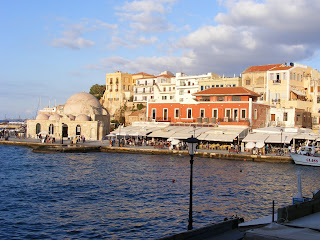
We flew to Crete on 2nd Oct for 10 days. I had sailed into Heraklion in 1980 and visited Knossos, but knew little more about the island. I learnt a little Greek, but the whole tourist industry speaks English more or less competently, so I seldom had a real conversation where I had to communicate in Greek! Crete’s history has been one of foreign occupation for most of the past 2000 years. It was the cradle of the first known major civilization on European soil, the Minoan, between approximately 3000 BC and 1450 BC. It was then incorporated into first Dorian and then Hellenistic Greece until conquered by the Romans in 67 BC. On the fall of the Western Empire in the C5th it passed into the hands of the Byzantine Empire (with a century in Arab hands 824-961 AD) until conquered by the Venetians in 1204. They held the island until it was wrested from them by the Turks in the mid C17th. The rest of Greece threw off Turkish rule in 1821, but in Crete the occupiers hung on until 1898, when the island became independent for a few years before it was united with the rest of Greece in 1908. It was held by the German army from 1941 until 1944 when most of the island was liberated. The German garrison in Chaniá held out until May 1945. We started with a couple of days in Chaniá in the NW corner. It was an important Venetian fortified harbour as the city’s fabric bears witness, although a few mosques and other vestiges of Turkish rule remain. There is a Venetian mole with a lighthouse, a big “bastion”, city walls, the governor’s palace, monastery, shipyards, etc. We stayed in a little hotel with a view over the harbour and found the Greeks charming and friendly almost without exception. The city boasts a fine orthodox cathedral, an architectural museum (in part of an old Franciscan monastery) with a fascinating collection of coins, and a naval museum with a model of the Battle of Salamis, inter alia. Naturally we looked for places to dance, although on the whole our stay was disappointing in that respect. On the first evening we set out for a long and fruitless walk round the town looking for places where we were assured there would be dancing. On our return, by mere chance we found a bar immediately opposite our hotel (across a street less than 3 metres wide) with live music – a laouto (Greek lute) and a guitar. The building had no roof, but with the warm weather that did not matter. A group of about 15 people, apparently an end-of-season office party, came in and before long they were on their feet. Magda joined in one dance, but we were so tired (having got up at 3 a.m. for our flight) that we did not stay for more. The next day we explored Souda, the modern port in the outskirts. As we were having lunch the guitar player from the previous evening came past so we stopped him for a chat. He said that they were playing again that evening, which was the bar’s closing night of the season. So we went. This time there were three musicians: our friend, now playing the laouta, another playing the oud (a similar but older lute-like instrument) and a third the lira – a sort of three-stringed viella or treble viola played on the knee. It is a typical instrument of Greek folk-music. No one danced! Our next visit was to Elos, a tiny village in the mountains of western Crete famed for its chestnut festival. There was not much going on but we walked up into the hills among the chestnut trees and found 3 or 4 delightful, tiny country churches. As we came out of the tiniest of the three, a local farmer appeared with basket of little ripe figs and offered us a couple each. Here my Greek was put to its first serious test! In the village there was a wood-carver with a Mexican flag outside his shop; he explained that there were so many imported Chinese products in Greece that he refused to be Greek until Greece recovered its self-respect. On Monday we left Chaniá on the 9 a.m. bus for Plakias on the south coast to meet up with Nicholas, an English friend from Chile. He lived in Crete many years ago, owning a sailing boat and a donkey! I went for a couple of good walks in the mountains while Magda spent time on the beach. We had supper in a little place looking over the bay and ate snails as we watched the sun set. In restaurants you only order the starters and/or main dish (a couple of starters are often sufficient) and wine or beer. Clean tap-water is almost always available and when you order your bill they bring you a small portion of sweet pastry or fruit and yoghurt, and a little decanter of rakis – like Italian grappa. It is advisable not to finish the decanter, even between two of you! From there we headed east, changing buses in the old-established tourist resort of Agia Galini with its big, smart hotels. We arrived for the night in the commercial city of Mirés, hoping to find a B&B and a hire car. We found neither! Magda went exploring and entered a little restaurant where she explained our problem. Of course – said Ireni behind the counter – we have a friend with a little apartment to let, my sister will drive you there! And so it was all fixed up in a trice. As soon as we had settled in we took the bus a few miles east to the archaeological site of Gortys, which was the Roman capital of Crete and an important city. There was a 6th century church of St Titus (undergoing restoration) and a fairly well-preserved theatre. The rest was pretty much heaps of loose stones which reminded me of Easter Island! There was another theatre more or less excavated and recognizable, a forum and some temples, but nothing very easy to visualise. The most evocative sight was an olive tree, estimated to be over 1,600 years old, embracing a piece of Roman pillar! We returned for dinner – the only customers – at our friendly restaurant where Ireni’s mother Margarita did the cooking. She was one of the last 10 on the Masterchef competition for Greece and in the past has worked as a cook for various VIPs. We ate very well, then Ireni put on some music and the four of us did a couple of dances. It was a delightful evening.